MARTIN WEINSTEIN | Nothing Goes Away: CASTELLO 925 · Venice, Italy

Weinstein seeks to decompress the experience of memory from a photo album of brief scenes to the longer durations of transitions of light, subtle movements of forms, and the integration of pure observation with experience.
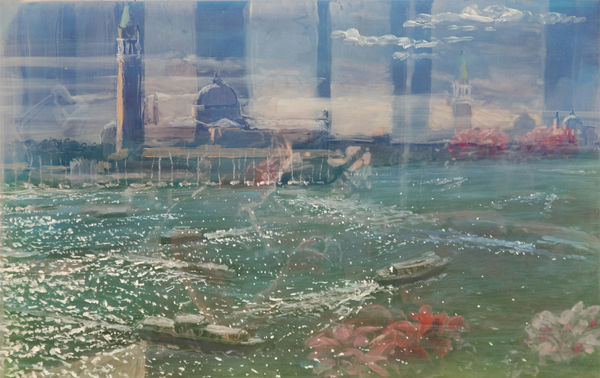
For years, Martin Weinstein has painted Venice, mostly from a particular balcony overlooking the Lagoon. It is from this perch that the interaction of the clouds with the sun and water is best perceived. Small percussive details, such as boats, flowers, and domestic shadows, complement the dramatic light that defines the architecture both inside and outside. These views of Venice not only serve as vehicles for atmospheric light and color but also as the setting for exploring a new dimension of pictorial space.
In Weinstein’s paintings, the water’s surface is the turning point between what can and cannot be seen. The surface acts as a mirror for what lies above, and the reflected image, in turn, partially obscures what lies below. To extend this imagery, the transition between what is outside and what is inside shifts with the point of view: from below the water, there is a clear view of the sky, whereas from above, the surface is obscured, reflecting the sky back onto itself. It is in these vertices that Martin Weinstein dwells - the edges of space. To further explore this phenomenon, the artist has developed a painting technique that deconstructs space into transparent acrylic layers encased in a clear plastic container. Each layer is positioned to interact with the other while the box itself channels and amplifies the ambient light, bringing the scene to life as a painterly diorama.
It's important to note that Martin Weinstein has a longstanding fascination with theater construction, with its layers of scenic flats defining the spatial environment and the concept of the proscenium, or fourth wall, which is dissolved so that the audience can perceive the action. Within Weinstein’s paintings, all perspective originates with the viewer, and the traditional ordered illusion of foreground, middle ground, and background is rearranged as layers that should logically sequence front to back become realigned to create a less linear and more orbital spatial experience: What is behind is now in front, transforming the passive viewer into an active participant. This recombined prismatic space exhibits a dimensional origami, as the illusion is both folded and unfolding depending on the angle of perception.
Despite the geometric fabrication of the acrylic layers encased in these customized boxes, Weinstein is an improviser, allowing the moment of time to be his model. This accounts for the gestural velocity of his brushwork, racing the constantly changing light and hellbent on capturing fleeting details. Weinstein’s paintings feature elusive highlights ballasted by equally fugitive shadows- each phenomenon dependent on the existence of the other, yet often isolated from one another on discrete painted layers only to be recombined retroactively in the eye of the viewer.
In Weinstein’s world, there is a sense of urgency, as the scene changes as rapidly as a conversation: light constantly skids across surfaces, clouds form and reform in seconds, and quiet shadows emerge and lengthen with the random shifts of the day. Because of these exigencies, Weinstein often paints, like Monet, in multiples, returning to the scene at different times of the day to recapture similar phenomena. In Venice, Evenings, Inside Over Outside, One Year Over Another, there is as much as a year between the layers in the painting, but the staccato points of light over the interior of the room have the specifics of an instantaneous event.
In other paintings, it is the reorganization of the layers that gives the sensation of surrounding space. Toward the Lido, Morning Over Evening, Outside Over Inside provides an all-encompassing sensation of the room behind the viewer, paradoxically presented as layered over the landscape with the deft highlights on the water intruding in front of the window, pushing the domestic scene behind the horizon, positioned as if it is a background thought. In Venice, Dawn Over Dusk, Weinstein seeks to align two distinct times of day, sunrise and sunset, so that the light phenomena balance and amplify one another.
Beyond the mechanics of physically separating the layers of perception, Martin Weinstein also describes the sensation of memory. Although memory is subjective and non-linear, the shared experience of what is remembered is an existential construction composed of scenic stills and paraphrased conversations. However, recollections do not have the same duration as the original event: It doesn’t take an hour to remember an hour. Weinstein seeks to decompress the experience of memory from a photo album of brief scenes to the longer durations of transitions of light, subtle movements of forms, and the integration of pure observation with experience.
Straddling two timeframes at once - both past and present - Weinstein’s paintings depict the paradox of the inner eye, represented by the interior space of a room, merging together with the outer eye whose gaze remains fixed on the horizon. This dual imagination is made particularly clear in the Ca’ di Dio paintings. The round windows are at once portals to the outside and geometric slices of the implied spherical space encompassing the painting. The importance of the positioning of the painted acrylic layers is indicated by the titles. In Ca Di Dio, Azalea, Inside Over Outside, and Ca di Dio Regatta, Inside Over Outside, Weinstein asserts that the inside painted layer is over the outside. This placement allows us to view the scene from within the room, from the artist’s perspective, looking out. In Ca di Dio Clouds and Sun, Outside Over Inside, and in Ca di Dio, Mornings, Outside Over Inside, we are now required to reverse our understanding of the sequence. The outside layer, placed over the interior scene, allows for a more direct experience of the exterior environment and transforms the inside scene into a background mirage.
These spatial shifts force the viewer to experience Weinstein’s world in a visceral way. There are no fixed points in Martin Weinstein’s world, only the transition from one moment to another. The multilayered construction compels us to move physically to understand the multiple, ever-shifting perspectives. Although the artworks are defined by their quadratic geometry, their transparency allows the dynamics of a spherical space to resonate against the constraints of the painting’s edges, like the surface of a soap bubble.
Apart from capturing the phenomenon of space, Martin Weinstein’s paintings are also simply responses to what is loved: a garden, a flower, the sun through the clouds, the city of Venice, his wife, Tereza, his friends, the calm of an afternoon, the atmosphere preceding a storm… for Weinstein, the list is both vast and intimate and serves as wordless journal entries. Each object is a subject of equal value: a petal’s edge is as important as the turbulent clouds of an oncoming storm; the outline of a cup and saucer is rendered as intently as the profile of San Giorgio. There is, at once, a celebration of life and all its manifestations, as well as an implied melancholy about the potential for loss. The painting, in its boxed configuration, becomes a poignant package where all these fleeting nanoseconds coalesce into an eternity, and Weinstein’s vision is delivered to us as a gift. The most beautiful city in the world, Venice, is ours, and the artist’s depiction of both nature and the work of human hands gives us hope. One feels a determination to document every moment, as if to stretch memory back to its original form and relive the past to its fullest extent. By offering us his world, Martin Weinstein’s paintings compassionately invite us to experience the intensity of our own lives and of those we love.
- Jen Dragon, Feb 2026
-
 Martin WeinsteinCa Di Dio, Azalea, Inside Over Outside, 2024acrylics on multiple acrylic panels
 -
Martin WeinsteinCa di Dio Regatta, Inside Over Outside, 2024acrylics on multiple acrylic panels
-
Martin WeinsteinCa di Dio Clouds and Sun, Outside Over Inside, 2024acrylics on multiple acrylic panels
-
Martin WeinsteinLagoon Sunrise, Outside Over Inside, 2024acrylics on multiple acrylic panels
-
Martin WeinsteinVenice, Sunsets, Inside Over Outside, 2024acrylics on multiple acrylic panels
-
Martin WeinsteinSanta Maria Maggiore Mornings, Outside Over Inside, 2024acrylics on multiple acrylic panels
-
Martin WeinsteinToward San Giorgio, Morning Over Afternoon, Outside Over Inside, 2025acrylics on multiple acrylic panels
-
Martin WeinsteinToward the Dogana, Early Evenings, Inside Over Outside, 2024acrylics on multiple acrylic panels
-
Martin WeinsteinCa di Dio, Mornings, Outside Over Inside, 2024acrylics on multiple acrylic panels
-
Martin WeinsteinSan Giorgio, One Afternoon Over Another, 2025acrylics on multiple acrylic panels
-
Martin WeinsteinSanta Maria Della Salute, One Morning Over Another, 2025acrylics on multiple acrylic panels
-
Martin WeinsteinToward The Salute, One Evening Over Another, 2025acrylics on multiple acrylic panels
-
Martin WeinsteinVenice, Afternoon Over Evening, 2025acrylics on multiple acrylic panels
-
Martin WeinsteinVenice Late Afternoon Over Evening, Outside Over Inside, 2025acrylics on multiple acrylic panels
-
Martin WeinsteinVenice, Dawn Over Dusk, 2025acrylics on multiple acrylic panels
-
Martin WeinsteinVenice, Evenings, Inside Over Outside, One Year Over Another, 2025acrylics on multiple acrylic panels
-
Martin WeinsteinVenice, Cloudy Afternoons, Outside Over Inside, 2024acrylics on multiple acrylic panels
-
Martin WeinsteinVenice, Looking South, Outside Over inside, 2024acrylics on multiple acrylic panels
-
Martin WeinsteinToward the Lido, Morning Over Evening, Outside Over Inside, 2025acrylics on multiple acrylic panels
-
Martin WeinsteinToward Giudecca, Afternoons, Outside Over Inside, 2025acrylics on multiple acrylic panels
-
Martin WeinsteinVenice, Evenings, Outside Over Inside, 2025acrylics on multiple acrylic panels
-
Martin WeinsteinVenice, One Sunset Over Another, 2025acrylics on multiple acrylic panels
-
Martin WeinsteinVenice, Sunset Under Noon, Inside Over Outside, 2025acrylics on multiple acrylic panels
-
Martin WeinsteinVenice, Evenings, Outside Over Inside, (John and Katie), 2024acrylics on multiple acrylic panels
-
Martin WeinsteinVenice, Sunsets, Outside Over Inside With Bad News, 2025acrylics on multiple acrylic panels
-
Martin WeinsteinVenice, Sunsets, Outside Over Inside, 3 Years, 2025acrylics on multiple acrylic panels
-
Martin WeinsteinVenice, Mornings, Outside Over Inside, 2025acrylics on multiple acrylic panels




|
|
This catalgoue accompanies the solo exhibition of paintings by Martin Weinstein on view at Castello 925, Venice Italy during the 61st Venice Biennale 5 May - 26 July, 2026 | opening reception/vernissage Sat. 8 May, More info: https://bit.ly/weinsteinvenice26
Design by Susanna Ronner Graphic Design | www.susannaronner.com
Essay: Jen Dragon
